
If you’re thinking about ibogaine, one question probably keeps coming back: what is it actually going to feel like? That’s a fair thing to ask. You’d be giving a full day and night of your life to a medicine you’ve never taken, in a country you may never have visited.
Here’s the honest answer from our team in Rosarito. The ibogaine experience isn’t a party, and most people wouldn’t call it a “fun trip.” It usually feels like a long, vivid waking dream, then a quiet night of thinking, then a day or two of feeling worn out. It can be hard work. For a lot of people, it’s also one of the most meaningful nights of their lives.
The short answer: Ibogaine usually starts working within 1 to 3 hours. A dream-like phase with visions lasts about 4 to 8 hours, then a calmer, reflective phase follows. Most of the strong effects fade within 24 to 36 hours. Expect visions with your eyes closed, nausea, heavy and unsteady legs, and very little sleep the first night.
Before the Dose: What Happens First
Nobody here takes ibogaine the day they arrive. Your stay starts with an EKG and a full blood panel, so our doctors can check your heart and liver and look over every medication you take. If you use fentanyl, methadone, Suboxone or kratom, you may need a few switch days first so the timing is safe. You can see how the whole week works on our ibogaine treatment page, and everything we treat on our ibogaine for addiction page.
The flood dose usually happens on day 2 or 3 of your 7-night stay. Before then, we’ll tell you when to stop eating, when to take your last dose of anything you’re coming off, and what the night will look like. Ask us anything. Feeling nervous is normal, and talking it through helps.
The Room Where It Happens
Many people find us while searching for ibogaine in Tijuana. Our clinic is in Rosarito, just down the coast, and your session takes place in a private room, not a hospital ward. The lights are low. A light projector fills the ceiling and walls with soft, slow-moving color, and a playlist made for the journey plays in the background. You lie in a real bed with pillows and blankets.
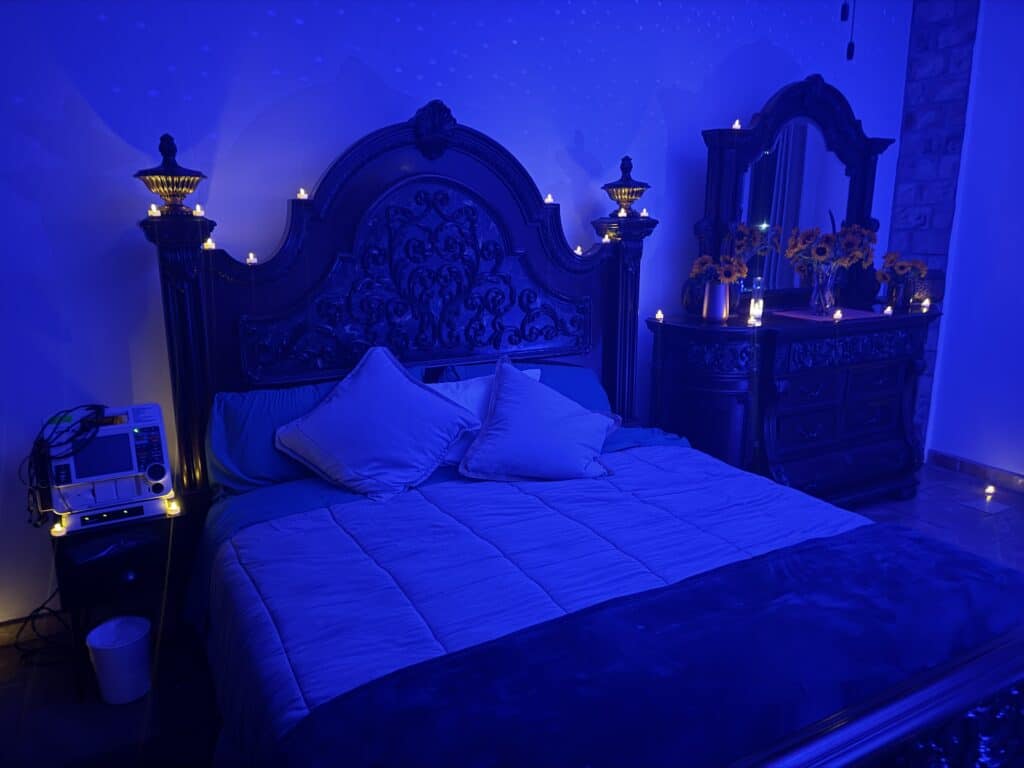
You’re connected to a heart monitor the whole time. Two doctors and a full nursing staff are there through your session. The nurses check on you, help you turn over, and bring water or a bucket when you need one. You’re not left alone with it.
The low light isn’t only about mood. Researchers who studied ibogaine sessions noted that the visions are stronger in a dark room with your eyes closed. A calm room with gentle music gives the experience space to unfold, without noise or bright light pulling you out of it.
The Ibogaine Experience, Hour by Hour
Everyone’s night is a little different. Your dose, your body and what you’re coming off all play a part. But most people go through the same three phases, which researchers first described decades ago.
Hours 0 to 3: Coming On
Within an hour or two, your body starts to feel heavy. Many people notice a buzzing or humming sound, or a feeling of vibration. Moving your head can bring on nausea, so most people lie still with their eyes closed. Throwing up is common in these early hours, and the nurses are ready for it. Some people feel a wave of nerves as it begins. That passes.
About Hours 2 to 10: The Dream Phase
This is the part people talk about. With your eyes closed, you may see scenes play out like a film: memories from childhood, people you’ve lost, moments you’d forgotten, or places and images that seem to come from nowhere. Many people say they watched these scenes rather than being swept away by them. They could look at a painful memory without being swallowed by it.
With your eyes open, the room mostly looks like the room, maybe with some patterns or movement around the edges. You can usually talk if you need something, though most people don’t want to.
About Hours 8 to 24: The Thinking Phase
The visions fade. Your mind gets quiet and clear, and people often find themselves going back over what they saw. It’s usually calm and steady rather than emotional. You’ll still be lying down, your body still heavy, and sleep usually won’t come yet.
Days 1 to 3: The Long Tail
The strong effects wear off within a day or so, but you may feel tired and wired at the same time. Sleep is light for a night or two, and your legs stay wobbly, so staff help you to the bathroom. Some people have a flat, low day afterward, sometimes called a “grey day.” It’s common, and it passes.
Your body turns ibogaine into a substance called noribogaine, which stays in your system for days. That’s one reason your heart is watched beyond the night of the dose.
What Does Ibogaine Feel Like in Your Body?
The mental side gets most of the attention, but the physical side is what surprises people most.
- Heavy, unsteady legs. Trouble walking (doctors call it ataxia) is one of the most common effects. In a 2022 Dutch study, every patient needed support to walk for a while after the dose. Plan on staying in bed and asking for help to get up.
- Nausea. It’s strongest early on and when you move. Lying still helps.
- Sensitivity to light and sound. Bright light and loud noise can feel like too much, which is why the room is kept soft and quiet.
- Changes in heart rhythm. You won’t feel these, but the monitor can see them. Ibogaine can slow your heart rate and lengthen a part of the heartbeat called the QT interval, which is why heart monitoring matters.
- Not much sleep. Expect to be awake through most of the first night.
How Long Does Ibogaine Last?
For most people, the main ibogaine experience lasts about a day and a night. Here’s a typical timeline after a flood dose:
| Phase | Starts | Lasts about | What it’s like |
|---|---|---|---|
| Dream phase | 1 to 3 hours after the dose | 4 to 8 hours | Visions with eyes closed, memories, nausea, heavy body |
| Thinking phase | 4 to 8 hours after the dose | 8 to 20 hours | Visions fade, calm reflection, still awake |
| Long tail | 12 to 24 hours after the dose | 1 to 3 days | Tired but alert, light sleep, wobbly walking |
Higher doses can stretch these phases out. That’s another reason you stay with us for the full week instead of heading home the next morning.
What About Withdrawal and Cravings?
For many people coming off opioids, the biggest surprise is what they don’t feel. In a 2017 survey of 88 people who took ibogaine for opioid use, most said their withdrawal symptoms were gone or much lighter, and about half said their cravings dropped.
That was a survey where people reported on themselves, with no comparison group, so it isn’t proof. Ibogaine isn’t FDA-approved, and it doesn’t work the same way for everyone. But it matches what people often describe the morning after.
Is the Ibogaine Experience Scary?
It can be, and we won’t pretend otherwise. Some visions are hard to watch: old grief, guilt, things you’ve tried not to think about. The nausea isn’t pleasant either. People who do best usually let it come instead of fighting it, and they remember that what they’re seeing is a memory, not something happening right now. If trauma is a big part of your story, our page on ibogaine for PTSD and trauma explains how we approach it.
You also won’t go through it alone. The doctors and nurses in the room have sat with many people through this night. And the hard parts are often the ones people talk about most afterward.
Two of our past clients put it in their own words. “Sarah,” who came to us for anxiety, said she saw her anxiety as a tangle of threads during her session: “I could finally step back and unravel it.” “James,” who came after years on opioids, faced memories of loss he had been running from. “It was like meeting myself again,” he said. You can read their full stories in Real Stories: How Ibogaine Treatment Changed My Life.
Why the Setting Matters
Because ibogaine affects heart rhythm, it should never be taken alone, at home, or anywhere without heart screening and medical staff on hand. If you’re still comparing places, our side-by-side look at ibogaine retreats and medical clinics lists the questions to ask any provider before you book.
The setting matters for the mind too. A calm room, gentle music and people you trust make it easier to relax into the experience instead of bracing against it.
After: The Days That Follow
The rest of your week is for recovering. Your appetite comes back, sleep slowly returns, and your legs steady. Meals are taken care of, and our team is there around the clock.
Before you go home, we talk through a plan: who you’ll call, what to steer clear of, and what to do if cravings come back.
One important safety note: after ibogaine, your tolerance to opioids is lower. Using the amount you used before can cause an overdose. Keep naloxone (Narcan) where you and the people around you can find it.
Frequently Asked Questions
Do you lose control on ibogaine?
Not in the way most people fear. You stay aware that you’re in the clinic, and you can usually answer a question or ask for help. Your body feels too heavy to get up and wander, which is part of why staff stay close.
Will I see things with my eyes open?
Mostly no. The visions come with your eyes closed. With your eyes open, you may notice patterns or movement, but the room looks like the room.
Can I talk during the experience?
Yes. Most people would rather stay quiet, but you can tell the nurses if you feel sick, need water or need the bathroom.
Does everyone throw up on ibogaine?
Not everyone, but nausea is common, especially in the first few hours. Lying still helps, and the nurses have it handled.
Will I remember the ibogaine experience?
Most people remember a lot of it, especially the visions. Some details blur, the way a dream does after you wake up.
Is there music during the session?
Yes. A playlist made for the journey plays softly in your room, along with a light projector that fills the room with gentle color.
Ready to Talk It Through?
If you still have questions about what the night will be like, we’re happy to answer them before you decide. Apply for treatment or call us at (619) 485-0198. You can also see what’s included on our ibogaine treatment cost page.
Sources
- Alper KR, Lotsof HS. The use of ibogaine in the treatment of addictions. In: Psychedelic Medicine, Vol. 2. Praeger; 2007.
- Davis AK, Barsuglia JP, Windham-Herman AM, Lynch M, Polanco M. Subjective effectiveness of ibogaine treatment for problematic opioid consumption: short- and long-term outcomes and current psychological functioning. Journal of Psychedelic Studies, 2017.
- Knuijver T, Schellekens A, Belgers M, et al. Safety of ibogaine administration in detoxification of opioid-dependent individuals: a descriptive open-label observational study. Addiction, 2022.
- Koenig X, Hilber K. The anti-addiction drug ibogaine and the heart: a delicate relation. Molecules, 2015.
- Global Ibogaine Therapy Alliance. Clinical Guidelines for Ibogaine-Assisted Detoxification, 2015.